Welcome to the Patanjali Yoga Sutras study circle — a calm, practical place to explore one of the foundational “maps of the mind” in the yogic tradition.
This thread is for:
-
Beginners who want a plain-English understanding
-
Practitioners who want to apply sutras in daily life
-
People from modern paths (Isha / AoL / SRF / Osho / Advaita communities, etc.) who want shared language without forcing agreement
What we’ll do here
-
Keep discussion practical and grounded
-
Share experience + interpretation + questions
-
Respect different commentaries and lineages
-
Avoid “guru wars” and superiority debates
Quick structure (for context)
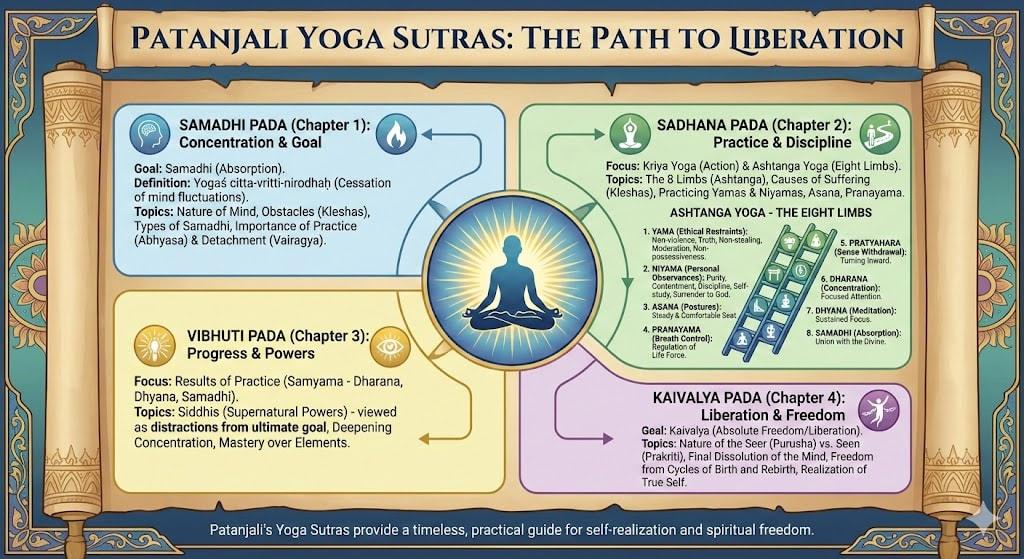
The Yoga Sutras are often grouped into four pādas:
-
Samādhi Pāda — attention, concentration, meditative absorption
-
Sādhana Pāda — practice, obstacles, discipline
-
Vibhūti Pāda — attainments / capacities (and cautions)
-
Kaivalya Pāda — liberation, freedom from identification
This thread is a cross-school comparison focused on how teachings show up in practice, not on proving who’s “right.”
What we’re exploring
-
Which Sutra ideas are central in each school (even if they don’t quote Patanjali directly)
-
How each school interprets “practice” (abhyāsa) and “non-attachment” (vairāgya)
-
How the Sutras map (or don’t map) onto modern program structures (courses, initiations, retreats, etc.)
-
How schools handle advanced experiences (samādhi / siddhi talk, devotion, inquiry, silence)
Reply template (copy/paste)
-
School / org: (e.g., Isha / AoL / SRF-Yogoda / Osho / Ramana community / other)
-
What part of the Sutras feels most “alive” there?: (Yamas/Niyamas, Dhyana, Samadhi, Kriya Yoga, Ishvara-pranidhana, etc.)
-
How it’s taught: (programs, daily sadhana, satsang, retreats, service)
-
What changed in your life/practice: (practical outcomes)
-
Where it differs from “classical” Sutras (if at all):
-
1 question you still have:
Patanjali’s Yoga Sutras are often treated as a “root text” of yoga, but modern schools apply them very differently. Sometimes explicitly, sometimes implicitly.
This thread is a cross-school comparison focused on how teachings show up in practice, not on proving who’s “right.”
1) The “8 limbs” mapping (optional)
If your school has a “pathway,” where do these fit?
-
Yama / Niyama (ethics + inner discipline)
-
Asana / Pranayama (body/breath)
-
Pratyahara (sense-withdrawal)
-
Dharana / Dhyana / Samadhi (concentration → meditation → absorption)
2) Kriya Yoga in modern schools
Patanjali’s “kriya yoga” (discipline/inner work) is interpreted very differently today.
-
How does your school define “kriya” (if it uses the word at all)?
-
Is it more about inner transformation, breath + energy, devotion, or inquiry?
3) “Ishvara-pranidhana” (surrender) vs “self-inquiry”
Some schools emphasize devotion/surrender; others emphasize inquiry/witnessing.
-
How does your school handle surrender without blind belief?
-
How does it handle inquiry without becoming overly intellectual?
4) Obstacles + remedies
The Sutras name obstacles (restlessness, doubt, laziness, etc.).
- What does your school actually do when a student hits these?
5) Advanced experiences: integration, not chasing
How does your school teach people to relate to powerful experiences (silence, bliss, intensity, energies, “mystical” moments) without chasing them?